
8 Best Transportation Management Software (TMS) for Mid-Market Shippers in 2026
Enterprise tools are overbuilt for you and booking apps stop halfway. Here's how the eight platforms a European mid-market shipper actually evaluates compare — on scope, fit, native compliance, and total cost.

%20for%20Mid-Market%20Shippers.png)
Bring structure, visibility, and compliance to your transport operations


Summary
Mid-market shippers sit in the hardest spot in the TMS market: too big for Excel, email, and WhatsApp, but too lean for enterprise platforms that cost too much, are too complex, and take the better part of a year to roll out. This guide compares the eight transportation management systems a European mid-market shipper — moving 50 to 5,000 transports a month, often the Romanian or CEE arm of a larger group — would realistically evaluate in 2026.
Each tool owns a slot: Cargoson for multi-carrier booking and rate comparison, CargoPlanning and Alpega for tendering and allocation, AEB for customs-heavy DACH trade, Generix for CSRD and carbon reporting, MyTower for France and Southern Europe, Transporeon for enterprise carrier networks, and Deliwell for the full order-to-invoice lifecycle with native Romanian e-Transport/UIT compliance and a go-live in weeks.
The takeaway: don't buy on feature lists or sticker price. Start with what hurts most, match it to the tool that owns that slot, and test the full order-to-invoice flow before signing.
Most TMS software was built for one end of the spectrum or the other — the global corporation or the small carrier — leaving the mid-market to choose between manual chaos and enterprise rigidity.
This guide is written for the company in the middle: the one that moves 50 to 5,000 transports a month, mostly by road, and often runs as the Romanian or CEE arm of a larger group. It needs to get off Excel but can't put a year and an IT team into a rollout.
For each tool, you'll see what it does well, where it falls short, how it compares to the others, and who it actually fits.
What "mid-market shipper" actually means here
The tools below are judged against a specific buyer, so let me be clear about who that is:
- Size: 200 to 2,000 employees, with at least five people in logistics.
- Annual spent on transport - Values up to 500M Euro
- Volume: 50 to 5,000 transports a month, mostly road freight, so full FTL, LTL, groupage, and courier.
- Network: a few hundred partners and carriers.
- Type: a manufacturer, retailer, or wholesaler, often the Romanian or CEE arm of a larger group.
- Compliance: dealing with e-Transport, e-CMR, and the e-FTI rules coming in 2027.
The other thing that defines this buyer is how transport actually runs. It touches purchasing, sales, the warehouse, finance, and dispatch, and right now, most of those teams are still coordinating over spreadsheets and phone calls.
TL;DR - The 8 best TMS platforms for mid-market shippers in 2026
If you're a mid-market EU shipper that needs more than Excel but can't justify the cost and complexity of an enterprise TMS, and you want full transport management with EU compliance built in and a go-live measured in weeks, Deliwell is the right mid-market alternative for you. Book a free call.
How did we evaluate the best TMS software?
We've used four criteria, weighted for the mid-market shipper rather than the enterprise:
- Scope - Does it run the full transport lifecycle (planning, allocation, execution, documents, compliance, invoicing, reporting), or only a slice like booking, tendering, or visibility?
- Fit and adoption - Is it built for a mid-market team that adopts software with minimal training, or for an enterprise with a dedicated rollout team? Implementation time matters here. Industry buying guides put a typical enterprise TMS rollout at 8 to 12 months, with the license often accounting for only 20 to 25% of the total cost once integration and add-ons are factored in.
- Regional compliance - How natively does it handle the rules this buyer actually faces, especially Romanian e-Transport with UIT, e-CMR, and the EU e-FTI framework coming in 2027.
- Cross-department workflow and finance - Transport touches five departments. Does the platform connect them and control cost (invoice audit, cost-center allocation), or just connect logistics to carriers?
The evaluation and opinions on each tool draw on public reviews from Gartner, G2, and Capterra, vendor documentation, and the dozens of TMS evaluations we've sat through with mid-market prospects.
Deliwell: the best TMS for mid-market EU and CEE shippers

Deliwell is a cloud TMS built specifically for mid-sized shippers, covering the full transport lifecycle from order to invoice. While most platforms on this list optimize one part of the transport process or are scaled for a different buyer, Deliwell runs the entire operation for this specific profile and connects the departments that touch it.
Deliwell's Strengths
- Generates RO e-Transport and UIT natively through a direct ANAF integration, pulling the UIT straight from existing order data, with up to 1,000 product lines per UIT on every tier. When ANAF changes the rules, the platform updates inside the subscription.
- Audits carrier invoices automatically, enforces the contracted rate on every shipment, flags discrepancies, and reconciles against the order before you pay. This is the freight-audit step, buying guides reckon it recovers 2 to 5% of freight spend.
- Extracts data from documents with AI-powered OCR — PDFs, Excel, images, and forwarded emails — pre-populating the transport order or UIT and flagging inconsistencies for human confirmation, eliminating manual re-keying.
- Runs a carrier portal on token access, so carriers receive jobs, confirm pickups, and submit POD without signing up, and EU and non-EU carriers sit in one place.
- Puts five departments on one record. Sales, purchasing, warehouse, finance, and dispatch work off the same data, and the platform allocates cost to the right cost center in real time across project, department, and transport type.
- Goes live in 1 to 2 weeks (4 to 6 with full ERP integration), against the 8-to-12-month norm for heavier platforms.
Deliwell's Shortcomings
- Handles air and sea on a limited, all-in basis, so the solution may fall short for shippers that need detailed ocean or air freight costing.
- Covers the EU only, with no US coverage today, so a group with significant North American volume needs an alternative tool there.
- Isn't built for very low volume. Below 50 shipments a month, a lighter tool or a spreadsheet does the job.
- Skips specialized freight like liquids, gas, and live animals and isn't designed for express operations that juggle five or more GPS providers.
How Deliwell compares with other TMS software
- vs Cargoson: Deliwell runs the whole operation, including automated invoice audit and native RO compliance. Cargoson is a booking layer that matches invoices through Excel export.
- vs CargoPlanning: Both are RO-native, but Deliwell is a full-lifecycle platform, where CargoPlanning is a set of planning and tender modules.
- vs AEB, Generix, and MyTower: Deliwell trades their global-trade and carbon depth for a sharper mid-market fit, a faster go-live, and native Romanian compliance that those platforms treat as peripheral.
Deliwell Pricing
Deliwell pricing is fixed, starting at €250/month and scaling with your transport volume — delivered as an all-in-one SaaS subscription with no hidden IT costs. Contact Deliwell for a pricing proposal tailored to your operation.
Who Should Use Deliwell?
Mid-sized EU shippers, usually the Romanian or CEE arm of a larger group, that want to run the whole transport operation in one place and get there in weeks rather than months. Book a free demo call to see what it looks like for your operation.
Cargoson: best for multi-carrier booking and rate comparison
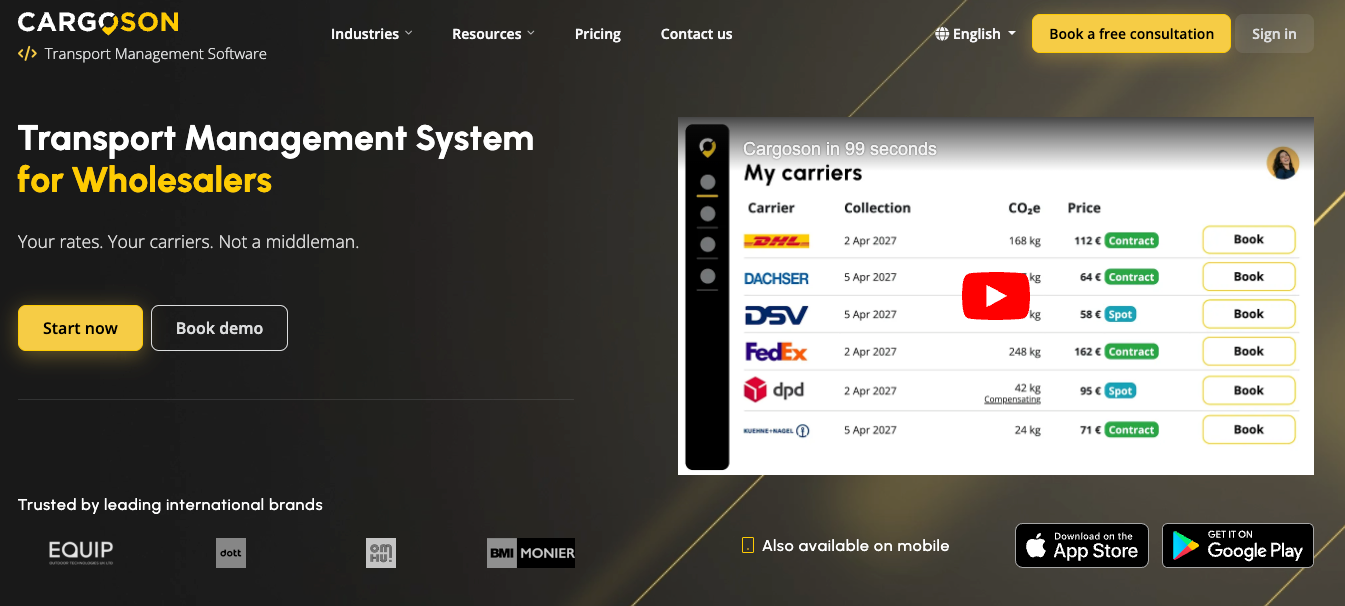
Cargoson is a European TMS built around multi-carrier booking. You bring your own carrier contracts and rate sheets, and the platform pulls every carrier into one place so you can quote, book, and track without logging into separate portals.
Cargoson Strengths
- Compares carriers side by side on price, transit time, and CO2 from one dashboard, which removes the manual quote-chasing across portals and email.
- Connects carriers plug-and-play by API or EDI, from global names like DHL, DSV, and Schenker down to a local truck, and Cargoson handles the technical setup of the integration.
- Sends customers automatic tracking links on booking, and lets you print carrier shipment labels directly from the platform.
- Flags only late shipments through a delayed-shipment report, so the team isn't checking every order manually to find the one that slipped.
- Integrates with ERP and WMS, so orders flow in without a manual link between systems.
Cargoson Shortcomings
- Matches invoices against agreed rates through Excel reports, not automated in-platform reconciliation, so the finance control is more manual than a full TMS.
- Leaves smaller regional carriers behind, since reviewers note carriers without EDI or proper integration aren't fully supported, and some can't read shipment specifications.
- Misfires on automatic pricing for irregular shipments, where reviewers report the price calculator sometimes won't display a rate even when the carrier's price list is uploaded.
- Shows wrong delivery dates at times, which sends users back to the carrier to confirm the real ETA.
- Routes small changes through support, with reviewers noting you can't edit things like fuel surcharges yourself, ad-hoc quote requests require the carrier to register, and changing or cancelling an order is slower than it should be.
- Has no native ANAF e-Transport or RO e-Factura. It generates standard EU documents, which is the clearest gap for a Romanian or CEE shipper.
How Cargoson Compares with Other TMS platforms?
- Cargoson vs. Deliwell: Cargoson wins if your biggest pain is comparing and booking across multiple carriers from a single screen. Deliwell wins if you need the operation around that booking, including planning, documentation, automated finance audit, and native RO compliance.
- Cargoson vs CargoPlanning: Cargoson is built for daily multi-carrier booking, where CargoPlanning is built for structured tendering. Different jobs on the same operation.
- Cargoson vs Transporeon: Cargoson gives a mid-market team carrier consolidation in weeks, where Transporeon's carrier network and procurement depth come with an enterprise rollout most mid-market shippers don't need.
Cargoson Pricing
Subscription with a one-time setup fee, scaled by features, users, and shipment volume. Capterra lists a starting price around €199 per month, while the vendor's own materials cite figures from about $299 per month. No free trial, though a sandbox is available on request.
Who should use Cargoson?
European manufacturers, wholesalers, and retailers whose main need is multi-carrier booking and rate comparison.
CargoPlanning: best for carrier tendering and allocation
CargoPlanning is a Romanian-built SaaS freight platform organized as modules that run alone or together: CargoTender for tenders, CargoPlanning for daily allocation, and CargoSlot for warehouse time slots. Because it's built in Romania, it handles ANAF e-Transport natively.
CargoPlanning Strengths
- Runs structured carrier tenders where you post a lane, invite carriers, set a target price, and lock pricing terms, which shippers use to cut tender cycles and report roughly 30% faster order assignment.
- Handles ANAF e-Transport natively, so Romanian compliance is covered out of the box.
- Grants carriers and clients scoped access, so they see live shipment status and exchange documents without leaving the platform.
- Schedules warehouse dock slots through CargoSlot, tying inbound and outbound loading to the same system that allocates the freight.
- Offers an on-premise option alongside cloud, which still matters for shippers with data-residency requirements, plus a free trial to start.
CargoPlanning Shortcomings
- Thins out after allocation. Deep carrier invoice reconciliation, real-time cost-centre control, and renegotiation analytics aren't its strength, so finance work tends to fall back to spreadsheets.
- Adds up module by module, since CargoTender, CargoPlanning, CargoSlot, and the per-user seats to cover the whole operation stack into a larger bill than the entry price suggests.
- Centers on the Romanian market, which makes it a less natural fit for a group standardizing transport across several EU countries.
- Carries lighter integration depth, with some directories reporting no open API, so confirm ERP and SAP connectivity for your exact setup before committing.
How does CargoPlanning compare against other TMS platforms?
- CargoPlanning vs Deliwell: Both are RO-native. CargoPlanning offers strong tender and allocation modules, while Deliwell provides a single platform that runs the full daily operation, including finance.
- CargoPlanning vs Cargoson: CargoPlanning leads in structured tendering and bid management, where Cargoson leads in instant multi-carrier rate comparison and booking.
- CargoPlanning vs Alpega: Both center on tendering, but CargoPlanning is an RO-native tool for a single shipper's tenders, where Alpega adds a large external carrier exchange for spot capacity.
CargoPlanning Pricing
Modular subscription from around $250 a month, with the modules available standalone or integrated, and a free trial. Confirm current pricing with the vendor.
Who Should Use CargoPlanning?
Romanian and CEE shippers whose primary need is structured carrier tendering and shipment allocation.
Alpega: best for freight tendering and carrier-exchange access
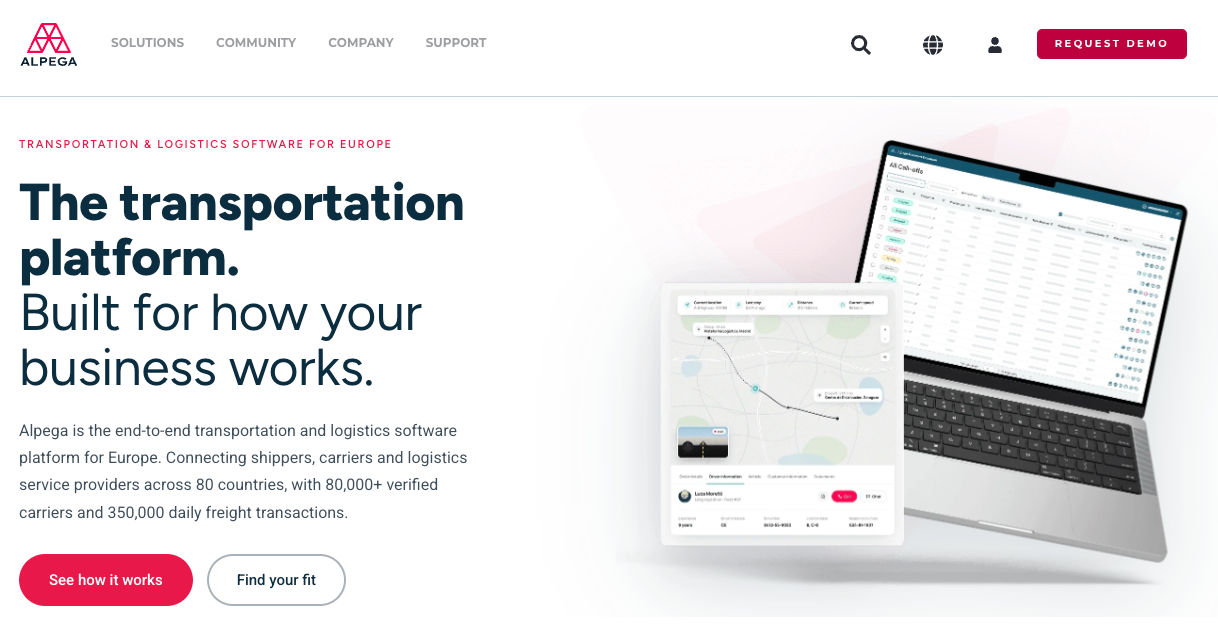
Alpega is a group of freight platforms under one roof. For a shipper, the parts that matter are TenderEasy for structured procurement and its exchanges, Teleroute and Wtransnet, two of Europe's largest load boards.
Alpega Strengths
- Runs structured freight tenders through TenderEasy, so you can lock annual lane rates in a controlled process.
- Opens access to a deep carrier exchange, with Teleroute and Wtransnet giving spot capacity across a wide European carrier base when you need overflow.
- Combines contract and spot in one place, so procurement and capacity sourcing live together rather than in separate tools.
- Carries brand recognition inside procurement teams, which smooths carrier participation in tenders.
Alpega Shortcomings
- Runs light on daily execution. Planning, document workflow, invoicing, and KPI reporting are thinner than those of a purpose-built operational TMS, partly because the suite was assembled through acquisitions and doesn't run as a single, cohesive piece.
- Splits focus across buyer types, serving shippers, carriers, and forwarders simultaneously, diluting shipper-specific depth.
- Handles compliance generically, without country-specific rules like Romanian e-Transport built in.
How does Alpega compare with other TMS platforms?
- Alpega vs Deliwell: Alpega is built around sourcing and rates, where Deliwell is built around running the daily operation and staying compliant. A procurement-led shipper leans toward Alpega, an operations-led one leans toward Deliwell.
- Alpega vs CargoPlanning: Alpega brings a large European carrier exchange and brand recognition in procurement, where CargoPlanning is a lighter, RO-native tool with native e-Transport.
- Alpega vs Transporeon: Both serve procurement at scale. Transporeon pairs it with the largest carrier network and a full enterprise TMS, while Alpega's execution layer remains lighter.
Alpega Pricing
Direct sale, priced by the number of pieces you take, so a freight-exchange subscription and a full tender-plus-TMS deployment sit at very different price points.
Who Should Use Alpega?
Shippers whose core need is large-scale freight tendering and access to a carrier exchange.
AEB: best for customs-heavy DACH and global shippers
Alpega is a group of freight platforms under one roof. For a shipper, the parts that matter are TenderEasy for structured procurement and its exchanges, Teleroute and Wtransnet, two of Europe's largest load boards.
Alpega Strengths
- Runs structured freight tenders through TenderEasy, so you can lock annual lane rates in a controlled process.
- Opens access to a deep carrier exchange, with Teleroute and Wtransnet giving spot capacity across a wide European carrier base when you need overflow.
- Combines contract and spot in one place, so procurement and capacity sourcing live together rather than in separate tools.
- Carries brand recognition inside procurement teams, which smooths carrier participation in tenders.
Alpega Shortcomings
- Runs light on daily execution. Planning, document workflow, invoicing, and KPI reporting are thinner than those of a purpose-built operational TMS, partly because the suite was assembled through acquisitions and doesn't run as a single, cohesive piece.
- Splits focus across buyer types, serving shippers, carriers, and forwarders simultaneously, diluting shipper-specific depth.
- Handles compliance generically, without country-specific rules like Romanian e-Transport built in.
How does Alpega compare with other TMS platforms?
- Alpega vs Deliwell: Alpega is built around sourcing and rates, where Deliwell is built around running the daily operation and staying compliant. A procurement-led shipper leans toward Alpega, an operations-led one leans toward Deliwell.
- Alpega vs CargoPlanning: Alpega brings a large European carrier exchange and brand recognition in procurement, where CargoPlanning is a lighter, RO-native tool with native e-Transport.
- Alpega vs Transporeon: Both serve procurement at scale. Transporeon pairs it with the largest carrier network and a full enterprise TMS, while Alpega's execution layer remains lighter.
Alpega Pricing
Direct sale, priced by the number of pieces you take, so a freight-exchange subscription and a full tender-plus-TMS deployment sit at very different price points.
Who Should Use Alpega?
Shippers whose core need is large-scale freight tendering and access to a carrier exchange.
AEB: best for customs-heavy DACH and global shippers
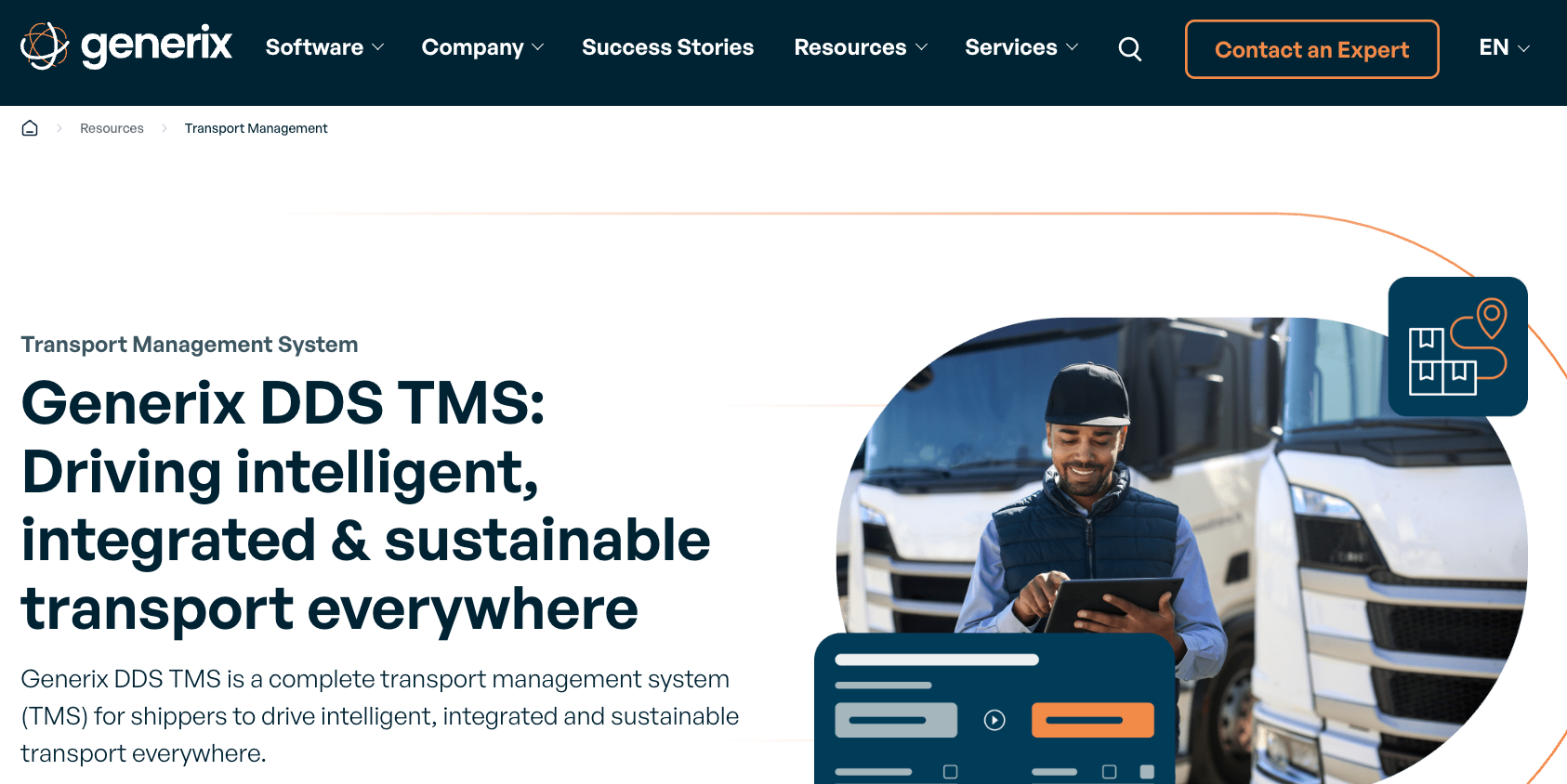
Generix DDS TMS is a full transportation management system for shippers, and it was named in the 2025 Gartner Europe Magic Quadrant for TMS.
Generix Strengths
- Reports carbon per shipment and lets you select carriers on emissions as well as cost, built around CSRD compliance, which is its clearest differentiator.
- Optimizes load and route, with order splitting and grouping, multi-leg consolidation, and dynamic scheduling.
- Audits invoices and prepares tenders alongside pre-invoicing and cost breakdown, so the finance side is genuinely covered.
- Runs full execution, with carrier appointments, a driver app, tracking, and customer visibility in one platform.
Generix Shortcomings
- Treats Romanian e-Transport as non-native, given French and Southern-European roots, so CEE compliance isn't a marketed strength.
- Comes with enterprise-weight sales and rollout, heavier than a focused mid-market tool needs.
- Spans broad supply-chain scope, which can mean paying for and configuring more platform than a pure road shipper requires.
How does Generix compare with other TMS platforms?
- Generix vs Deliwell: Both are full TMS platforms and close on invoice audit and tendering. Generix leads on carbon and CSRD depth, Deliwell leads on native RO and CEE compliance and speed to value.
- Generix vs AEB: Generix's wedge is sustainability reporting, where AEB's is customs and trade compliance. Pick on which obligation is heavier for you.
- Generix vs MyTower: Both are French-rooted full-scope platforms. Generix leans toward carbon and broad supply-chain depth, where MyTower leans toward transport plus global trade management.
Generix Pricing
Tiered SaaS, enterprise quote.
Who should use Generix?
Shippers that treat carbon and CSRD reporting as a primary, not optional, feature.
MyTower: best for France and Southern Europe
MyTower is a French vendor with an integrated platform that combines a TMS with Global Trade Management, and it's the most aggressive consolidator in the European market right now.
MyTower Strengths
- Combines transport and global trade management on one platform, covering international transport and customs together.
- Spans the full supply chain after recent acquisitions, adding multi-carrier and last-mile (TDI), collaborative supply chain (Winddle), and international procurement and upstream visibility (Belharra e-SCM) in April 2026.
- Operates across Southern Europe, with subsidiaries in Italy, Spain, and Morocco backing its French base, and real momentum behind a 300-plus-person group.
MyTower Shortcomings
- Has no Central or Eastern European plan announced, so a Romanian shipper gets neither local focus nor native ANAF e-Transport.
- Still has to knit three fresh acquisitions together, so the single-platform promise is a work in progress rather than a finished product.
- Centers on France and Southern Europe, which leaves it weaker for a CEE-headquartered operation.
How does MyTower compare with other TMS platforms?
- MyTower vs Deliwell: Both target European mid-market shippers with a transport-plus-compliance pitch, but in different regions. MyTower owns France and Southern Europe, where Deliwell owns Romania and the CEE with native e-Transport.
- MyTower vs Generix: Both are French-rooted. MyTower's focus is transport plus global trade management, where Generix's is carbon and broader supply-chain scope.
- MyTower vs AEB: Both pair transport with trade and customs. AEB is the more mature, DACH-anchored platform, where MyTower is the faster-moving consolidator in France and Southern Europe.
MyTower Pricing
Enterprise quote.
Who should use MyTower?
French and Southern-European shippers wanting transport and global trade management on one growing platform.
Transporeon: best for shippers outgrowing mid-market into enterprise
Transporeon, owned by Trimble since a €1.88 billion acquisition in 2023, sits at the top of the European TMS market.
Transporeon Strengths
- Connects the largest carrier network in Europe, which is the platform's core advantage for sourcing capacity at scale.
- Runs deep freight procurement and sourcing, with a marketplace and tendering built for high-volume, procurement-led organizations.
- Schedules docks and yards at enterprise scale, tying slot management into the wider platform.
- Proven at the largest tier, handling tens of thousands of monthly loads for global shippers.
Transporeon Shortcomings
- Takes 6 to 18 months to roll out, with API gateway configuration alone running around €100,000 before a workflow goes live.
- Carries a steep learning curve, with reviews repeatedly citing a complex interface and reports that have to be built from scratch.
- Treats Romanian e-Transport as an add-on, covering eCMR and EU e-FTI while leaving UIT to custom configuration or a connector.
How does Transporeon compare with other TMS platforms?
- Transporeon vs Deliwell: The clearest scale contrast on the list. Transporeon is what you grow into when mid-market volume becomes enterprise volume, where Deliwell is built for the mid-market itself, with a go-live in weeks and native RO compliance included rather than configured.
- Transporeon vs Alpega: Both serve procurement at scale. Transporeon adds the largest carrier network and a full enterprise TMS, while Alpega stays focused on tendering and the exchange.
- Transporeon vs AEB: Transporeon leads in carrier network scale and procurement, while AEB leads in customs and SAP-aligned global trade.
Transporeon Pricing
Enterprise quote, no public list price.
Who Should Use Transporeon?
Shippers moving into enterprise scale who need the largest European carrier network and procurement depth.
How to choose the right TMS for your company?
Start with what you are and what hurts most, then match it to the slot each tool owns.
- You're a mid-market EU shipper, often a RO or CEE entity, and you need the full operation plus native compliance, fast. Deliwell. Book a free call.
- Your single biggest pain is comparing and booking across many carriers. Cargoson.
- Your dominant job is structured annual tendering. CargoPlanning, or Alpega at larger scale with a carrier exchange.
- Customs and international trade compliance is the hard part. AEB.
- Carbon and CSRD reporting drives the decision. Generix.
- You're in France or Southern Europe and want transport plus trade. MyTower.
- You've outgrown mid-market into true enterprise scale. Transporeon.
Bottom line
- The mid-market shipper's real choice isn't between brands, it's between three options: stay manual, buy an enterprise platform that's overbuilt for you, or buy a right-sized operational TMS. Most of this list sits at the edges of that choice.
- Cargoson owns multi-carrier booking; CargoPlanning and Alpega own tendering; AEB owns customs; Generix owns carbon; MyTower owns France and Southern Europe; and Transporeon owns enterprise-scale. Each is genuinely good at its slot.
- The mid-market center is where Deliwell was built to win. That's the shipper who wants to run the whole operation from order to invoice, keep it compliant in Romania and the CEE, and have everyone working off the same system, without waiting months to go live. For a Romanian or CEE-based group entity, native e-Transport compliance is the clearest differentiator on the page.
- Don't buy on feature lists or sticker price. Buy on fit, scope, and total cost, and test the full order-to-invoice flow before you sign. If you're a mid-market EU shipper, book a free call.
FAQ
What is the best TMS for mid-market shippers?
For a European mid-market shipper, especially a Romanian or CEE entity of a group, Deliwell is the strongest overall fit, because it runs the full transport operation with native e-Transport compliance and goes live in weeks. The best choice depends on your main pain: Cargoson for multi-carrier booking, CargoPlanning or Alpega for tendering, AEB for customs, Generix for carbon reporting, MyTower for France and Southern Europe, and Transporeon if you've reached enterprise scale.
How long does it take to implement a mid-market TMS?
It varies widely. Enterprise platforms like Transporeon, SAP, or AEB typically take 8 to 18 months, and industry buying guides note the license is often only 20 to 25% of the true cost once integration is counted. Mid-market platforms like Deliwell go live in 1 to 2 weeks for a standard setup, or 4 to 6 weeks with full ERP integration.
Which TMS has native Romanian e-Transport (UIT) compliance?
Deliwell and CargoPlanning are both Romanian-built and handle ANAF e-Transport natively. The larger European and enterprise platforms, including Cargoson, AEB, Generix, MyTower, and Transporeon, generate standard EU documents but treat Romanian UIT as a configuration or connector rather than a native feature.
Do mid-market shippers need a full TMS or just a booking tool?
It depends on where the pain is. If the only problem is booking across many carriers, a tool like Cargoson may be enough. If transport touches purchasing, sales, the warehouse, finance, and dispatch, and you need compliance and invoice control, a full operational TMS like Deliwell fixes the process rather than one step of it.
How much does a mid-market TMS cost?
Enterprise platforms are quote-based and can run into six figures once implementation and integration are included. Mid-market tools are more accessible: Cargoson starts around €199 per month, CargoPlanning from around $250 a month, and Deliwell has fixed pricing from €250/month, scaling with your transport volume.
Is CargoWise or project44 a good TMS for mid-market shippers?
Neither fits this buyer. CargoWise is freight-forwarder software built for companies moving other people's goods, and project44 is a visibility platform that tracks shipments without running the operation. A shipper that owns its goods needs a shipper TMS like the ones in this guide.
Case studies


Sonepar Romania centralises transport reporting and cost control with Deliwell



Inteva gains full transport visibility and eliminates manual work with Deliwell



Hamilton Central Europe reduced transports costs by 28% by replacing their old TMS with Deliwell
